

When companies first look at offshore hiring, they usually run into two models: BPO and EOR.
Both involve people working in another country. Both reduce costs. Both can help a business add capacity without opening a local entity.
A BPO, or Business Process Outsourcing provider, takes over a function and manages the people doing the work. An EOR, or Employer of Record, handles the legal employment side in another country so the client can hire and manage their own team there.
The difference is in what the company is actually buying: a managed service in a BPO model, or the infrastructure to build and employ a team in an EOR model.
The core distinction

A BPO is built to run a function for you.
An EOR is built to let you hire people in another country and manage them yourself.
That sounds simple, but it changes almost everything downstream.
A BPO takes over the service layer. The vendor manages the people, the process, and the delivery. The client usually interacts with account managers, service levels, and reports.
An EOR takes over the legal employment layer. The client still writes the job description, interviews candidates, chooses the hire, and manages the work day to day. The EOR sits underneath that as the legal and administrative employer in that country.
What a BPO is built to do
A traditional BPO works best when the company wants a vendor to run a defined function.
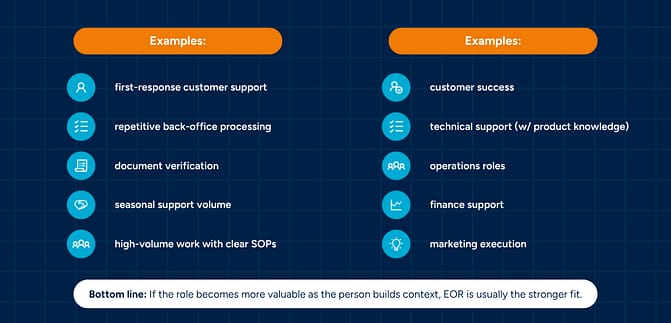
It fits work that is high-volume, tightly documented, and easy to measure. Think first-response support, claims processing, repetitive back-office work, document verification, or seasonal support surges.
Those are areas where consistency and speed matter more than product depth.
In that environment, BPO performs as intended. The vendor has the infrastructure, the training pipeline, and the management layer already in place. You can add fifty agents without running a hiring process.
The structural tradeoff is what most companies underestimate. In a BPO arrangement, you are not the manager. You interact through account managers, dashboards, SLAs, and reporting.
The workers identify with the BPO as their employer. They often serve multiple clients from the same floor. The knowledge they build about your product, your customers, your edge cases, accumulates inside the vendor's operation, not yours.
This produces a specific pattern of failure that is easy to miss:
- Attrition at the BPO resets your knowledge baseline. Agents optimize for the metric they are measured on, but not the outcome you actually want.
- SLA compliance can stay green while customer experience degrades. And when the contract ends, or when you try to switch vendors, much of what was learned leaves with them.
According to Deloitte's 2024 Global Outsourcing Survey, 76% of executives cite vendor management complexity and loss of control as their top challenges with outsourced operations.
BPO is optimized for a specific use case; and outside that use case, the model works against you.
What an EOR is built to do
An Employer of Record solves a different problem.
It allows a company to hire people in another country without incorporating a local legal entity. The EOR becomes the legal employer in that jurisdiction handling payroll, statutory benefits, tax compliance, and local employment law.
The client decides who to hire, what they work on, how they are managed, and whether they stay.
That means the company is building a team.
In practice, the working relationship between the client and the offshore employee looks structurally identical to any direct hire. The worker has one manager: the client. They work on one team. They build context about one product, one customer base, one set of internal processes.
The knowledge stays inside the client's business because the worker is, functionally, the client's employee.
The EOR makes the arrangement legally sound in the worker's home country.
This is the model LevelUp uses. The team member is legally employed through LevelUp in the Philippines, but they work as a dedicated team member for the client.
The client writes the role, interviews candidates, makes the final hiring decision, and manages the work directly. LevelUp handles the legal employment and administrative side.
What this changes in practice
The biggest difference is ownership.
In a BPO setup, the vendor owns and manages the service layer.
In an EOR setup, the client owns the team relationship and the work, while the EOR handles the employment layer.
That changes:
If the company wants long-term capability inside the business, this distinction matters.
What a client owns in an EOR setup
The EOR model requires you to manage.
A BPO takes the function off your plate, management included. An EOR takes the legal and administrative complexity off your plate, but the management responsibility stays with you entirely.
If you do not have the capacity, the tools, or the intention to manage a distributed team well, such as to onboard properly, communicate across time zones, build offshore workers into the culture, and give them a real career path, the EOR model will underperform.
A dedicated offshore hire needs deeper onboarding than a BPO agent stepping into a pre-built workflow. Three to six months before they are operating at full contribution is a realistic baseline. The long-term value compounds significantly.
A two-year employee with deep product context is a fundamentally different asset than a rotating agent pool. But getting there requires genuine management investment.
If that investment is not realistic right now, a BPO may be the more honest choice in the short term. The EOR model rewards companies that are ready to manage. It does not fix companies that are not.
What each model actually costs
This is where many comparisons get vague, so it helps to separate the pricing logic.
BPO pricing is typically per seat or per transaction. For customer support roles, rates commonly range from $8-$18 per hour depending on location, complexity, and whether you are in a shared or dedicated model.
EOR pricing works differently. You pay the worker's local salary plus an EOR service fee, typically $200-$650 per employee per month depending on provider and country.
In markets like the Philippines, Colombia, or South Africa, a skilled customer success or operations hire might earn $1,000-$2,000 per month in salary.
Total employer cost (salary plus EOR fee) remains 60-70% below the equivalent hire in the US, UK, or Australia, while the worker receives a competitive local wage with full legal protections.
So the comparison is not as simple as “BPO is cheaper” or “EOR is cheaper.”
The real question is what cost you are comparing.
A BPO may look simpler in the short term because the vendor is carrying management overhead inside the service price.
An EOR can look more expensive than local salary alone because you are adding the EOR fee. But the longer comparison is different.
Over time, the business also has to think about turnover, retraining, vendor dependence, and how much value the role builds inside the company.
Where BPO is the right fit for your business

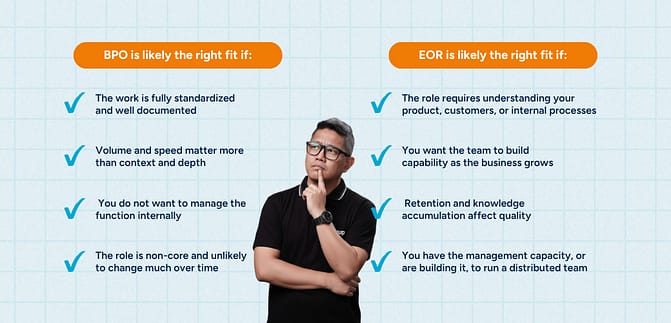
BPO is a good fit when the company wants a vendor to manage the work and does not need deep ownership of the team doing it.
That often applies when:
BPO can work well for burst capacity, mature support queues, repetitive admin work, and seasonal demand.
When EOR Gives You Direct Control Over Your Offshore Team

EOR starts to make more sense when the company wants direct control over the team and expects the role to become more valuable over time.
The EOR model usually applies to roles where context compounds:
These are usually not roles where constant reset is acceptable. They are roles where the company benefits when the same person stays, learns, and improves inside the business.
If you would not want a strong performer in this role to leave after six months, it probably should not be in a shared BPO pool.
What companies often underestimate about BPO
Companies often think they are buying simplicity, speed, and risk transfer.
In many cases, they are. But they may also be giving up deeper ownership of the team, closer cultural integration, and knowledge that compounds inside the business over time.
A BPO can still meet its service levels while leaving the client wanting more product understanding, more continuity, or a stronger customer experience than the model is really designed to produce.
The model is built around delivery, not around building a long-term team inside the client’s company.
What companies often underestimate about EOR
EOR has its own tradeoffs.
The company still has to manage. That means onboarding, feedback, communication, and team integration still sit with the client.
A dedicated offshore team member usually needs more context than someone stepping into a tightly managed vendor process. The report is clear that the payback period is slower at the start and that onboarding can take longer.
EOR is not the right fit for a company that wants zero management responsibility. It is the better fit for a company that wants control, retention, and long-term capability, and is willing to manage for that outcome.
A simple failure example
A BPO-style setup can work well for first-response support where the main goal is volume, speed, and coverage.
The same model can start to struggle if the company now needs the support team to know the product deeply, guide onboarding, solve more complex cases, and feed insight back into the business.
At that point, the company may still have offshore coverage, but not the level of ownership or product knowledge it actually wants.
This is usually where a different model starts to make more sense. The problem is no longer just adding capacity. It is whether the team can build knowledge, take on more ownership, and grow with the business.
A practical framework for deciding
LevelUp: An Offshore EOR Partner Built for Long-Term Team Building

LevelUp is an offshore partner for businesses that want to hire in the Philippines with a more deliberate and structured approach.
We do not treat hiring as a quick match. The search is built around the actual role, the team context, and the kind of person who can do the job well over time.
We also stay involved as a partner throughout the process. That means giving honest feedback, raising concerns when needed, and helping clients make sound hiring decisions instead of simply filling a seat.
Once the hire is in place, LevelUp takes care of the employment infrastructure in the Philippines, including payroll, HR, compliance, and benefits. The client keeps control of the work and the team relationship. That makes it a better fit for companies building a real offshore team over time.
The EOR model works well for companies that are ready to own their offshore team and that want a partner who understands the difference between building a team and buying a service.
If you are at the stage where that distinction matters, that is the conversation we are built for.

