

Outsourcing still cuts costs. That part has not changed. What changed is how outsourcing cost savings actually work today.
Founders still see the old promise: Hire in the Philippines and pay a fraction of US, UK, AU, or CA salaries. Keep 80%-90% of the wage gap as pure savings. See “rockstar” Filipino talent for three dollars an hour.
Reality looks different.
The old lift and shift model only looked at base salary. That model no longer works. If you still rely on it, you will overestimate savings and underbudget for what people need. The problem is not outsourcing. The problem is the financial model.
The Gap Between Gross Savings and Real Savings
The wage gap is real, but it is only the starting point.
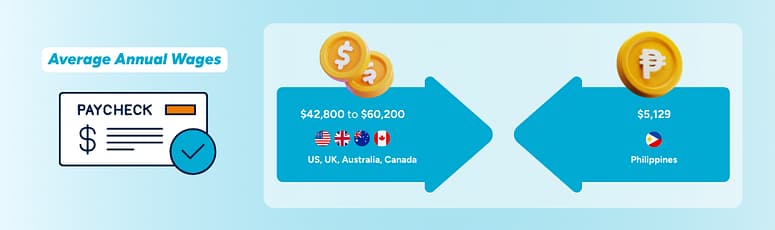
Across the US, UK, Australia, and Canada, average annual wages sit in the $42,800 to $60,200 range. In the Philippines, they sit around $5,129. That is an 80-90% difference.
Entry-level admin and support roles follow the same pattern. A $35,000 US role can map to roughly $4,200 in the Philippines. Mid-level specialists and senior managers show similar gaps.
If you stop there, the logic looks simple. Hire offshore. Pay 10-20% of the local rate. Keep the rest as savings. Many pitch decks still stop at this point.
However, once you move beyond the payroll, you face the Total Cost of Engagement. This is the full cost of employing a person in the Philippines in a compliant, sustainable way.
At a minimum, that includes:
Statutory contributions
SSS at a 15% rate on the Monthly Salary Credit, with 10% on the employer side. PhilHealth at 5% of basic salary, shared between employer and employee, capped at ₱100,000. Pag-IBIG at 2%.
These are non-negotiable. Non-compliance is a legal and financial risk, not a minor admin issue.
13th month pay
You must accrue an extra 8.33% of basic salary across the year. If you forget to model it, your December cash flow takes the hit. Many “cheap” comparisons skip this line entirely.
Private HMO and de minimis benefits
Statutory health cover is not enough for the top 20% of talent. Serious employers add private HMO, often ₱15,000 to ₱30,000 per employee per year, sometimes with a dependent.
They also use small tax-efficient allowances like rice or clothing. These are direct costs. They are also part of why good people stay.
Remote infra and reliability
A serious remote setup needs stable internet and power. That usually means internet stipends, backup lines, UPS units, or similar support. It is not huge per person, but it is real and recurring.
We also mapped this out in a short explainer that shows what realistic savings look like in real operations across SDRs and software engineers.
Example Cost Breakdown
Take a mid-level operations manager. The “cheap freelance” view might assume:
Total: $600 per month. That looks like $3.75 per hour.
A compliant EOR or professional employer view looks closer to:
Total: $2,100 to $2,500 per month. Effective rate around $13 to $15 per hour.
On paper, that looks like the cost “tripled”. In context, it is still a large saving. If the same role costs $6,000 per month in the US, you are still saving roughly $3,500 each month at a $2,500 fully burdened rate.
That is around 58%. The difference is that now you are looking at a model that is legal, stable, and attractive to serious professionals.
This context also depends on the hiring model you choose. You can see how the models differ in control and cost in the outsourcing vs offshoring guide.
Why Three Dollars an Hour Cannot Support Reliable Work

The three-dollar benchmark survives because it looks simple. Many founders see long lists of workers offering two to four dollars per hour. They assume those rates reflect the real market. They assume those rates can support stable, long-term work. They also assume that cheaper always means efficient.
The reality behind those numbers is very different.
Many workers offering those rates are entry-level. Some are new graduates. Some are in regions with unstable power and internet. Many have limited experience or limited tools. Some accept those rates only because they feel they have no choice.
Rising costs in the Philippines push them to take any role available, even if it is not sustainable.
This is also the tier with the highest risk of over-employment. At three dollars per hour, most workers cannot live on a single client. They stack multiple “full-time” roles to survive.
You expect forty hours. You receive ten to fifteen hours. The rest is split across other employers. There is a high chance the quality drops. The reliability drops.
Ghosting becomes common in this environment. It is not a character issue. It happens because people burn out or suddenly replace a low-paying client with a better opportunity. They disappear because the structure they work inside is fragile.
Transparency
There is also a transparency issue at the low end. Workers in this tier often feel watched and pressured by systems they cannot control. Some feel exposed by monitoring tools. Others feel trapped by “suggested salary” benchmarks that push rates even lower.
This drives a cycle where workers underprice themselves, clients expect the same low baseline, and the market becomes more unstable.
The result is predictable: Low rates produce high churn.
This is not a work ethic problem. It is a structural outcome of a market that pushes Filipino workers into low hourly rates that cannot support stable work.
Real outsourcing savings start when the foundation is sustainable, when people earn enough to focus on one job, stay long-term, and deliver consistent work. The three-dollar benchmark cannot support that.
What the Philippine Salary Market Actually Looks Like
These are the real numbers talent accepts today. Your savings come from wage gaps between countries. Not from underpricing the role.
For a closer look at how VA roles get priced and defined, the virtual assistant cost guide lays out the details.
Hidden Costs That Reduce Savings When the Model Is Wrong
There are four hidden costs that founders underestimate:
Attrition
Turnover in the Philippine BPO sector sits high. Replacing a hire can cost 50-200% of their annual salary. This comes from lost output, learning curves, training time, and recruitment fees.
Rework
Filipino culture avoids confrontation. People may attempt unclear tasks instead of asking for clarification. This doubles the work.
Management overhead
Remote teams need guidance, but communication takes time. Managers spend an extra 20% of bandwidth supporting offshore talent compared to local teams. That time has a financial value.
Compliance risk
Non-compliance with SSS, PhilHealth, Pag-IBIG, and 13th-month pay creates penalties. It also exposes the company to misclassification issues. Cheap freelance arrangements often ignore these rules. The hidden liability is not worth the tiny upfront saving.
Cultural norms also influence how people handle unclear instructions. The Philippines scores high in power distance, which means many employees hesitate to ask follow-up questions. This increases the risk of rework. You can see this pattern in the national culture data from Hofstede Insights.
Choosing the Right Engagement Model Matters

Companies usually choose among freelance, BPO, or EOR setups. Each one changes the cost structure and the reliability of the team.
Freelancers
Freelance hiring gives the lowest direct cost. It also gives the highest risk. Compliance, payroll, and retention fall entirely on the client.
Traditional BPOs
Traditional BPOs charge higher markups. They handle HR, facilities, and performance oversight. The tradeoff is less transparency. BPOs maximize their spread by paying talent as little as possible. That creates churn.
Offshore partners with EOR
Employer of Record models create stable cost-plus structures. The client chooses the salary. The EOR handles compliance, payroll, benefits, and HR. Full transparency stays in place. The employee receives competitive pay and real benefits. This lowers attrition.
This is why the EOR model has grown. It creates predictable and sustainable savings. It avoids the hidden markups of BPOs and the risks of freelance hiring.
Realistic Outsourcing Cost Savings in 2026
Savings still sit in the 50-70% range for most roles. These numbers rely on Philippine salaries, not artificially low rates. Real savings appear when you:
This is the level of structure that withstands scale and audits.
If you want outsourcing cost savings that hold up in real work, avoid paying three dollars. Build your numbers around compliance and retention. Budget for the real market. Choose a structure that matches your goals.

This is how you get the financial benefit without the churn or risk that wipes out the savings for most teams.

