

Understanding virtual assistant cost is harder than it looks. The numbers online jump from three dollars per hour to sixty dollars per hour. That range confuses founders who only want to know one thing. How much should I actually expect to spend if I need real support next year?
This guide looks at the 2026 market in a direct and practical way. It focuses on the numbers, the role variations, and the real factors that influence virtual assistant cost across different hiring models.
Why virtual assistant cost is hard to compare

A virtual assistant can mean different things depending on who you ask. Some see it as an admin role. Others use it for bookkeeping, marketing, or operations. The title is broad. The work is not. This gap creates most of the confusion around virtual assistant cost.
When the scope is unclear, the expected rate becomes unclear. A business owner may expect an admin rate for work that actually belongs in finance or marketing. This is why the pricing range looks wide and unpredictable across the market.
Why the Term “Virtual Assistant” Creates Confusion
The market groups several functions under one title. Each one carries a different skill level and a different rate. Here is the clearer breakdown.
General Administrative Support
Some virtual assistants focus on classic admin work. This includes email management, scheduling, notes, calendar changes, and simple customer follow-ups. These tasks sit on the lighter end of the skill spectrum, so the virtual assistant cost for this group usually stays on the lower range.
Specialized Administrative Support
Bookkeeping VAs deal with ledgers, reconciliations, receipts, and financial records. The work requires accuracy, training, and knowledge of accounting software. This moves the virtual assistant cost into a different range because the skill set is more specific.
Marketing and Digital Support
Marketing VAs help with basic campaign tasks, content coordination, social media posts, reporting, or tool setup. The virtual assistant cost in this group varies because some tasks are entry-level while others require deeper experience with platforms and analytics.
Operations and Systems Support
Operations VAs support processes, CRM tools, documentation, automations, data workflows, or project management. The virtual assistant cost for this role is often higher because the work affects system reliability and requires familiarity with technical tools.
Even when the title is the same, the actual work behind it differs. This is where the hiring process becomes difficult for many founders and business owners.
Looking at the numbers
To understand the virtual assistant cost for 2026, you need a simple benchmark. Here is the cleanest way to look at it.
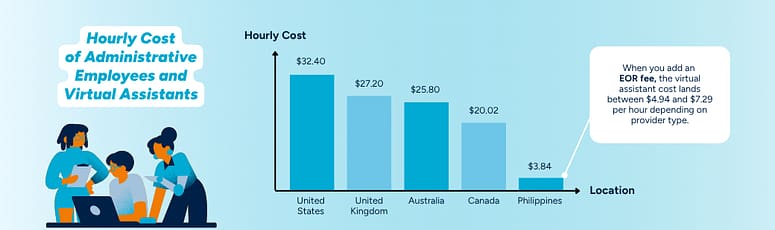
A full-time administrative employee in the United States has a fully loaded cost of about $32.40 per hour based on 2024 and 2025 government data. In the United Kingdom, it sits at around $27.20 per hour. In Australia, about $25.80 per hour. In Canada, about $20.02 per hour. These figures include wages and mandatory employer costs.
In the Philippines, that fully loaded cost is around $3.84 per hour. When you add an EOR fee, the virtual assistant cost lands between $4.94 and $7.29 per hour depending on provider type.
Local hiring and local freelancing may not create meaningful savings because they follow the same high baseline.
This is why most founders who want long-term support look offshore.
Virtual Assistant Cost Benchmarks (Hourly, 2026)
Local Hiring Benchmarks
Location (Local Employee) | Hourly Cost (USD) |
|---|---|
United States | $32.40/hr |
United Kingdom | $27.20/hr |
Australia | $25.80/hr |
Canada | $20.02/hr |
Offshore Virtual Assistant Benchmarks (Philippines)
Model / Provider Type | Hourly Cost (USD) |
|---|---|
Freelancer (PH) | $3.00–$10.00/hr |
EOR – Local Provider | $5.00–$10.00/hr |
LevelUp Dedicated VA | $9.00/hr |
Upper Range for PH Talent | Up to $12.00/hr |
Sources: US Bureau of Labor Statistics. UK Office for National Statistics. Australian Bureau of Statistics. Statistics Canada. 2025 Philippines salary benchmarks. EOR pricing data from local PH providers and LevelUp. 2024–2025 virtual assistant market rate reports.
Where business owners miscalculate virtual assistant cost

Business owners often underestimate the work involved in getting someone up to speed. Training takes time. Fixing early mistakes takes time. Reviewing tasks takes time. All of this sits on the founder’s calendar. Their time carries a higher value than the virtual assistant cost they are trying to save.
A business owner billing at $100 per hour loses more by doing admin work themselves. Twelve to fifteen hours per week spent on tasks that could be delegated creates a larger loss than the cost of hiring help. This part is easy to miss because the loss is not a direct expense.
Lower hourly rates usually mean entry-level experience. Entry-level support needs more checking and correction. This increases hidden cost even when the rate looks affordable. The owner feels the friction before they notice the pattern.
If you want to understand how an offshore hiring model reduces cost without lowering quality, the Audr case study walks through the full process.
Why long-term structures improve the value of the spend
A compliant structure gives the business fewer risks to manage. Retention improves when the role is treated as long-term employment instead of temporary support.
Employer of Record models grew because they remove operational load. Payroll and benefits are handled. Local laws are followed. Hence, the team member is legally employed. This arrangement is for stability. It also reduces the internal work a business owner needs to take on.
When the structure is organized, the virtual assistant cost stays manageable because the work is consistent and the time spent on corrections is lower.
Looking ahead in 2026

AI will continue to take over simple and repetitive tasks. Entry-level roles may keep a steady rate because the work is easier to automate. Higher-skill roles will likely increase in price because they use AI tools to improve output and handle more complex responsibilities.
This shift aligns with reports showing that routine jobs are the first to be automated.
Basic admin support will stay in the lower range, while specialist roles will continue to sit higher based on capability. Clear scopes help business owners place the role in the right range and keep virtual assistant cost predictable.
A clear job scope helps the business owner place the role in the right path. Clear expectations help the virtual assistant work efficiently. These factors keep virtual assistant cost predictable for the year ahead.
Bringing the factors together
Virtual assistant cost does not sit in one fixed number. It changes based on the role, the level of experience, the hiring model, and how stable the working structure is. A $5 rate and a $40 rate both exist because they support different types of work.
When the business owner defines the capability they need, the hiring process becomes clearer and the cost becomes easier to justify.

