


Hiring Offshore Paralegals in the Philippines: What You Need to Know
If you are looking at offshore paralegal support, you are probably feeling the pressure already. Your clients and leadership expect your legal team to handle more work without adding people at the same rate.
At the same time, technology has made it easier to share work across locations without losing oversight.
Offshore legal support did not grow because firms wanted cheaper labor. It grew because legal work itself changed. Tasks became easier to break into clear steps and the work followed the same patterns more often.
Attorneys kept control over review and approval, while preparation and support work could be handled elsewhere.
That shift is why Legal Process Outsourcing evolved into Knowledge Process Outsourcing. Offshore teams are no longer treated as external helpers. They are embedded into legal workflows with defined roles and clear limits.
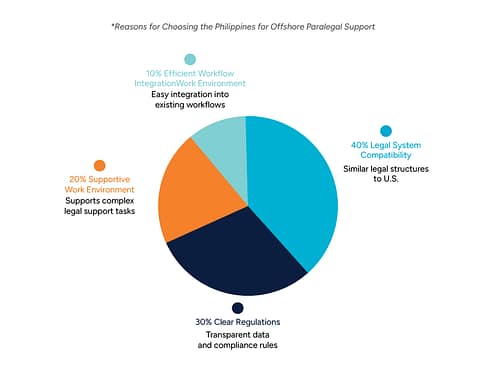
Many companies choose the Philippines for offshore paralegal work because its legal system, regulations, and daily work structures plug more easily into how U.S. legal teams already operate.
The legal system follows many of the same structures, the rules around data and compliance are clear, and the work environment supports more complex legal support tasks, not just repetitive work.
The real question for you is simple.
Can legal work move in your firm without shifting legal responsibility?
Alignment With the US Legal System
Offshore paralegal support only works when everyone is operating from the same legal playbook.
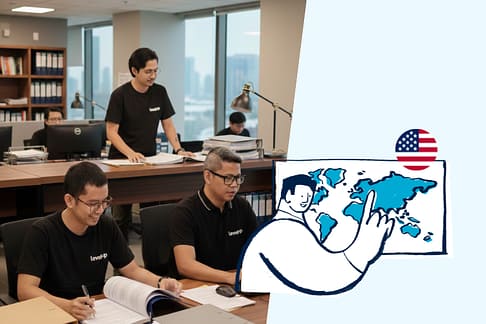
In the Philippines, the legal system developed during American administration and kept many elements of U.S. common law. The structure of government, the court system, and the rules of evidence closely resemble those used in the United States.
Many commercial laws, including corporate and securities laws, were patterned directly after U.S. legislation.
In practical terms, this means offshore paralegals are not learning a new system from scratch. They are working inside familiar legal structures. That reduces confusion and limits the back-and-forth explanations.
Language reinforces this alignment. English is the language of the courts, legal education, and contracts. Law schools follow U.S.-modeled curricula, and legal professionals are trained using American legal terms and procedures.
Other English-speaking countries can also provide legal support. The difference here is that language and legal structure align at the same time.
Paralegals can handle files in a way that fits how your team already works, which matters more than doing things fast when accuracy is the priority.
Supervision Is Key
Offshore paralegals do not change your ethical obligations.
Under ABA Model Rule 5.3, you remain responsible for the conduct of nonlawyer assistants, no matter where they are located. That responsibility cannot be passed on, and it does not weaken when work moves offshore.
Paralegals can support research, document preparation, and case organization. They cannot give legal advice, represent clients, or make independent legal decisions.
When problems occur, enforcement actions consistently point to weak supervision, not the use of offshore staff itself.
The J. Scott Spicer case is often referenced because it shows what happens when oversight is missing. A senior paralegal operated without clear attorney supervision and the result was a finding of unauthorized practice of law.
Make sure a licensed attorney reviews and approves all offshore work. Tell clients when you're using offshore support, especially if it involves sensitive data.
Data Privacy Matters
Offshore legal work is only possible because data protection laws allow it.
In the Philippines, that framework is the Data Privacy Act of 2012.
This law governs how personal and sensitive information is collected, processed, and stored, and it reflects many GDPR principles such as transparency, proportionality, and legitimate purpose.
Philippine data privacy law classifies offshore legal providers as Personal Information Processors.
Offshore paralegals must appoint a Data Protection Officer, put technical and organizational safeguards in place, and follow strict breach notification rules. Serious penalties apply for non-compliance, including criminal liability (National Privacy Commission guidance).
For you, this means there is a clear legal basis for handling client data offshore, as long as the safeguards are enforced.
Security Certifications

Regulation sets the rules you have to follow. Certifications show you whether those rules are actually being followed.
ISO 27001 requires a formal system for managing information security. It focuses on identifying risks, applying controls, and reviewing them regularly.
SOC 2, especially Type II, looks at whether those controls actually work over time, not just on paper.
In legal work, these certifications matter because they give you proof from an outside party that security rules are actually being followed.
They help you avoid guessing which vendors are safe to work with and let you rely on clear standards instead of promises.
Technology and Workflow
Offshore paralegal work today depends on systems, not location.
Case management platforms keep files, deadlines, and billing in one place. E-discovery tools help review large volumes of data using machine learning.
Security tools like Virtual Desktop Infrastructure keep data inside controlled environments and create audit trails for access and activity.
These tools do not replace attorney judgment. They make it easier for you to see how work moves and where review happens.
Gauging your readiness for offshore paralegal support
Legal Ownership
Offshore paralegal support works best when you address governance first.
When you evaluate an offshore provider, vendor due diligence should include reviewing legal history, financial stability, security practices, and system compatibility. This helps you confirm the provider is reliable, compliant, and able to work within your existing setup.
Service Level Agreements (SLAs) and Key Performance Indicators (KPIs) should prioritize accuracy and compliance, not speed alone, since legal work requires correctness over volume.
You can protect attorney-client privilege by labeling privileged materials and using contracts that state offshore support exists to assist in legal advice or litigation preparation.
Scope of Delegation
Offshore paralegal support does not shift responsibility for advice, filings, or outcomes. It moves preparation and support work into a different location while ownership stays with the attorney.
When your firm already enforces review, approval, and sign-off, offshore paralegals can integrate without disrupting professional responsibility. When those boundaries are missing, offshoring will not correct them. It will surface the gaps more quickly.
Decision Readiness
Readiness comes down to whether your firm can delegate legal support work while keeping full legal accountability in place.
LevelUp focuses on hiring experienced offshore paralegals in the Philippines and setting up the right employment and compliance structure around them.
We do not train paralegals and we do not step into legal decision-making. Your attorneys stay fully in control of supervision, review, and final responsibility.

We handle the operational side, employment, local compliance, and ongoing support, so your offshore paralegals can work as a stable, long-term part of your team rather than a temporary resource.
If your firm already has clear review and accountability in place, offshore paralegals can fit naturally into that structure. LevelUp is here to make that transition easier.


