


Hiring an Offshore SEO Specialist: What You Need to Know

SEO can involve very different areas of work, from content and on-page optimization to technical SEO and reporting. You may need someone who can work across several of these areas, or someone with deeper experience in one.
How much ownership they have can vary too. Some SEO specialists work from an existing strategy, while others are expected to identify opportunities, set priorities, and recommend what to do next.
When Should You Hire an Offshore SEO Specialist?
An offshore SEO specialist can be a good fit when SEO has become an ongoing workload rather than something your team handles occasionally.
You might have content waiting to be optimized or opportunities you've identified but don't have the capacity to act on. If you're an agency, the pressure may come from taking on more clients than your current team has the capacity to handle.
It also helps to think about whether you need another pair of hands or someone who can take ownership of SEO. If you already have a strategy and mainly need help carrying it out, the role may be more execution-focused. If no one is currently responsible for deciding what to prioritize, you'll probably need someone with enough experience to make those calls as well.
Getting that clear before you hire will make the rest of the search much easier.
If you're still deciding whether you need a dedicated hire, freelancer, or agency, our guide to hiring an SEO freelancer vs. an agency compares the different models in more detail.
What Type of SEO Specialist Do You Need?
Start with the SEO work you want to hand over.
If you need support across keyword research, on-page SEO, content, reporting, and some technical work, an SEO generalist may be the right fit. If most of the work sits in one area, it may be worth looking for someone with deeper experience there.
Type of SEO specialist | Main focus | When they may be a good fit |
|---|---|---|
SEO generalist | Keyword research, on-page SEO, basic technical SEO, content optimization, reporting | Agencies or marketing teams that need someone to handle a broad SEO workload |
Technical SEO specialist | Crawling, indexing, site architecture, performance, technical audits | Websites with complex technical issues or development-heavy SEO requirements |
Content SEO specialist | Search intent, keyword strategy, content briefs, optimization, internal linking | Businesses and agencies investing heavily in organic content |
Local SEO specialist | Local search visibility, business listings, location pages, local optimization | Businesses serving customers in specific geographic areas |
E-commerce SEO specialist | Product and category optimization, site architecture, indexation, commercial search visibility | Online retailers and e-commerce agencies |
You don't need to turn every possible SEO skill into a requirement.
Work out what they'll spend most of their time doing, which skills they need from day one, and where you're comfortable with someone learning as they go. That gives you a more realistic brief and a better way to judge candidates against the work they'll actually be doing.
If you want to go deeper into candidate requirements, our guide to hiring an SEO expert in the Philippines covers skills, salary benchmarks, hiring red flags, and interview questions.
How Do You Know If an SEO Candidate Can Do the Work?
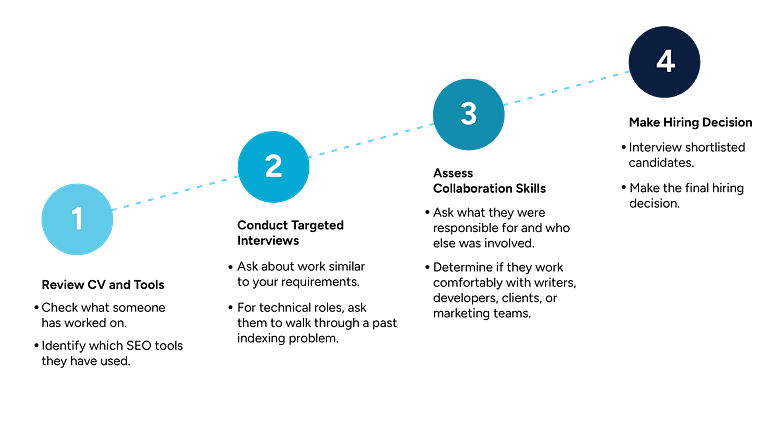
A CV can tell you what someone has worked on and which SEO tools they've used. But an interview can be very useful to help you understand how they approach the work.
Ask about work that's similar to what they'd be doing for you.
For a technical role, you could take an indexing problem they've dealt with before and ask them to walk you through it. Where did they start? What did they find? What did they recommend?
With someone more focused on content, you might talk through a page that wasn't performing well and ask how they worked out what needed to change. Their answer can tell you quite a lot about how they use search intent, data, competitor research, and their own judgment.
Past work is useful here too. Rather than only asking about results, ask what they were responsible for and who else was involved. SEO rarely happens in isolation, so it helps to know whether they can work comfortably with writers, developers, clients, or the rest of your marketing team.
You'll interview the shortlisted candidates and make the final hiring decision. You can read more about how LevelUp sources and screens candidates on The LevelUp Process page.
Does Your SEO Specialist Need Experience With AI Search?
Possibly, but it depends on the role you're filling.
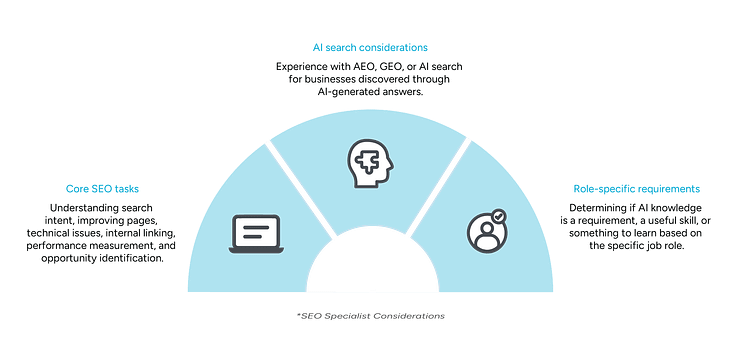
SEO still involves plenty of familiar work: understanding what people search for, improving pages, dealing with technical issues, internal linking, measuring performance, and working out where the next opportunities are.
AI search has added another consideration. People can now discover businesses and information through AI-generated answers as well as traditional search results. If that matters to your organic strategy, experience with AEO, GEO, or AI search may be useful when you're hiring.
It doesn't need to appear in every SEO job description.
A local SEO hire, for example, may have other experience that matters much more to you. The same could be true if you need a technical specialist to sort out a complicated site. For someone taking broader ownership of organic search, AI search knowledge may carry more weight.
It comes back to the work you're hiring them to do. That should determine whether AI search is a requirement, something useful to have, or something they can learn later.
Our guide to B2B SEO trends looks more closely at AEO, GEO, AI search, and how organic discovery is changing.


