


How Does a Property Management Virtual Assistant Act as the System Processor
If you manage properties long enough, there comes a point where the workload outgrows one person or even a small local team. This is often when companies start looking at a property management virtual assistant as a practical next step.
Leasing needs quick responses to avoid vacancies. Maintenance has to be tracked from request to completion. Rent follow-ups and owner reports run on fixed schedules. None of this requires new tools. It requires systems that stay accurate as the portfolio grows.
Most property management companies already run these workflows inside software. Adding another local property manager usually increases cost and coordination, but does not reduce the volume of operational work.
Because the work already happens online, many teams choose a property management virtual assistant to keep leasing, maintenance, and accounting systems updated instead of expanding the local team.
What a Property Management Virtual Assistant Actually Does
If you already use property management software, the core work of your business already runs through a few systems.
Listings, inquiries, maintenance requests, rent payments, and reports all pass through your property management platform.
A property management virtual assistant takes responsibility for keeping those workflows complete and current, based on the rules you set.
Instead of your local team switching between calls and admin, the assistant handles routine updates as they happen.
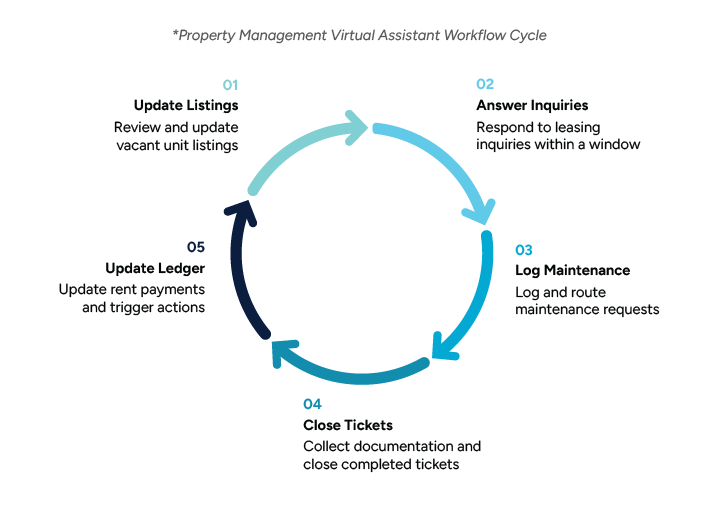
In practical terms, that usually means:
None of these tasks are complex, but timing is the risk.
If listings are not updated, you get inquiries for units that are no longer available. If maintenance tickets are not closed, owners ask why jobs look unfinished. If payments are not posted on time, reports do not match the bank balance.
You end up checking the system yourself just to be sure it is right. A property management virtual assistant takes care of this ongoing system work so you do not have to.
When you open your software, what you see reflects what is actually happening across the portfolio.
How a Property Management Virtual Assistant Supports Leasing
Keeping listings accurate when a unit turns over
Leasing starts the moment a unit is marked vacant in your property management system.
That status usually pushes the listing to multiple platforms. If the rent, photos, or amenities are wrong at this point, the mistake shows up everywhere.
A property management virtual assistant starts here.
When a vacancy is flagged in systems like Buildium, AppFolio, or Revela, the virtual assistant checks the listing details before it goes live. They are not writing marketing copy. They are making sure the information in the system is correct so you are not dealing with corrections later.
Responding to inquiries before prospects move on
Most leasing inquiries come in through listing sites or tenant portals.
If those messages sit unanswered, prospects move on to the next property. This is not about sales language. It is about response time.
The assistant monitors the leasing inbox and replies using messages you have already approved, either by email or SMS. Basic questions are answered. The inquiry is acknowledged. The lead stays warm.
Screening applications before they reach your desk
Before an application reaches you, the assistant checks that it meets your basic requirements.
Income thresholds, minimum credit criteria, and missing documents are reviewed first. Incomplete or unqualified applications do not land in your queue.
You review complete files only.
Coordinating showings without calendar back-and-forth
Showings are scheduled using the tools you already use, such as ShowMojo or Tenant Turner.
If you allow self-showings, the assistant manages access based on your rules. If you require in-person tours, they coordinate schedules without pulling your team into email threads.
You set the rules. They follow them.
Preparing leases and handing off to the local team
The assistant does not approve tenants or negotiate lease terms. Those decisions stay with you.
Once you approve an applicant, the assistant prepares the lease, collects the required documents, and updates the system. Your local team steps in for inspections, keys, and the physical move-in.
How a Property Management Virtual Assistant Handles Maintenance

Keeping track of maintenance is usually where things start to break down.
Requests come in throughout the day. Some arrive through the tenant portal. Others come by email or text. When they are not logged properly, they never fully enter the system. That is when gaps start to appear.
A common situation looks like this. A tenant reports an issue. A vendor completes the repair. The work gets done, but the ticket is never updated or closed. Days later, an owner checks the portal and still sees an open maintenance item. From their perspective, nothing seems to be happening, even though the problem was already fixed.
That disconnect creates confusion and extra follow-up.
With a property management virtual assistant in place, maintenance follows a consistent process.
Applying your troubleshooting rules before dispatch
Not every maintenance request needs a vendor.
For common issues, the assistant follows the same troubleshooting steps your team already uses. Simple checks are handled first. If the issue can be resolved without dispatch, it stops there.
When a vendor is needed, the assistant assigns one from your approved list and records the job details in the system. No guessing. No shortcuts.
Tracking work until it is actually finished
The job is not done when the vendor says it is done.
The assistant follows the request until it is closed properly. They check for updates. They request photos or invoices when required. They update notes and close the ticket once completion is confirmed.
When you open your maintenance dashboard, you see the real status of the property without chasing vendors or reconstructing timelines.
Setting Clear Spending Limits
Spending authority is usually your first concern when you move maintenance coordination offshore.
You solve this by setting written limits.
Most property management companies use a maintenance threshold. A common limit is $400.
You apply the same logic to tenant credits or refunds.
When limits are written down, your assistant does not guess. They follow the rule and escalate only when required.
Controlling Access Inside the System
You control risk through system permissions, not trust alone.
Most property management platforms allow you to define exactly what a user can see and do.
Typical setups include:
View-only or draft-only access to banking
Permission to prepare bills without releasing payments
Restricted access to owner financials
Individual logins instead of shared credentials
This allows your assistant to prepare work without the ability to move money or make irreversible changes.
Knowing When to Escalate
Not every issue should be handled offshore.
You define escalation rules early so there is no confusion.
Common escalation triggers include:
When these come up, your assistant pauses the workflow and flags the issue for you or your local manager.
How You Measure Performance
You do not measure a property management virtual assistant by hours worked. You measure output.
Common benchmarks include:
Response time to leasing inquiries
Time to close maintenance tickets
Accuracy of rent posting and invoices
Number of tasks returned for correction
Alignment between system data and owner reports
These metrics tell you whether your system is being maintained properly.
When accuracy stays high, you can grow without adding pressure to your local team.
Why response time matters
When people wait too long for a reply, they move on.
If a leasing inquiry is not answered quickly, the prospect looks at another listing. If a maintenance request sits without an update, tenants and owners start following up. If the system is slow to reflect what is happening, people assume nothing is being handled.
When response times are consistent, units fill faster and fewer issues escalate into problems.
When to hire a Property Management Virtual Assistant

A property management virtual assistant works best when:
Your systems are already in place
Most communication happens online
Your local team is overloaded with admin work
Growth is limited by follow-up and not demand
They do not fix broken processes. They keep working systems accurate and consistent.
Starting small and setting rules first
Most failures happen when work is handed over without rules.
Effective setups start with clear ownership. You define which tasks the assistant owns. You set approval limits. You lock down permissions. You document escalation rules. You review output weekly.
Once the system stays accurate without daily intervention, you can rely on the property management VA for more of the workload.
LevelUp supports property management companies that already run on software and need their systems maintained properly.
We hire full-time offshore property management virtual assistants. You keep ownership of decisions while we take care of the operational workload.


